Saturday, May 14, 2011

I Gorged on Mole, Cuitlacoche, and Dulces Tipicos

Sadly, I just returned from my last trip to the city center/ Zocalo, weekend Market, and Puebla's famous candy street. I'm returning to the United States tomorrow.

Jonathan and I started out the day by having a huge lunch at la Fonda de Santa Clara, a very old, traditional Mexican restaurant that panders to tourists. It is not hoaky or cheesy, like most Mexican restaurants in the United States, it is simply all things traditionally Pueblan.
The menu contains everything necessary to taste while in Puebla, like a one stop "eat your way through Puebla" deal. There is also a list of seasonal specialties, this month's specialty is an Aztec dish of century worms (that's how it was translated into English) cooked in a chile sauce served with beans and guacamole. Jonathan said it was a delicacy so I was very excited to order it. Unfortunalty, they didn't have it. (How do you not have the monthly special?!?) So I settled for Puebla's most famous dish: Mole. Half way trough my plate, I swapped with Jonathan for his adobo pork and cuitlacoche.


Mole: Chicken smothered in a complex sauce containing chocolate and nearly 100 other ingredients, sprinkled with sesame seeds and a side of rice.


It was difficult to see, but there was chicken under that sauce.

Adobo pork with Cuitlacoche and a side of guacamole. 

Close up of Cuitlacoche: a special type of mold that infects corn as it grows. Mexicans love it, they grow certain types that are particularly prone to molding. I was very excited to eat it and it had a sweet/ bitter taste that reminded me of bitter greens. The strip of white is cheese.


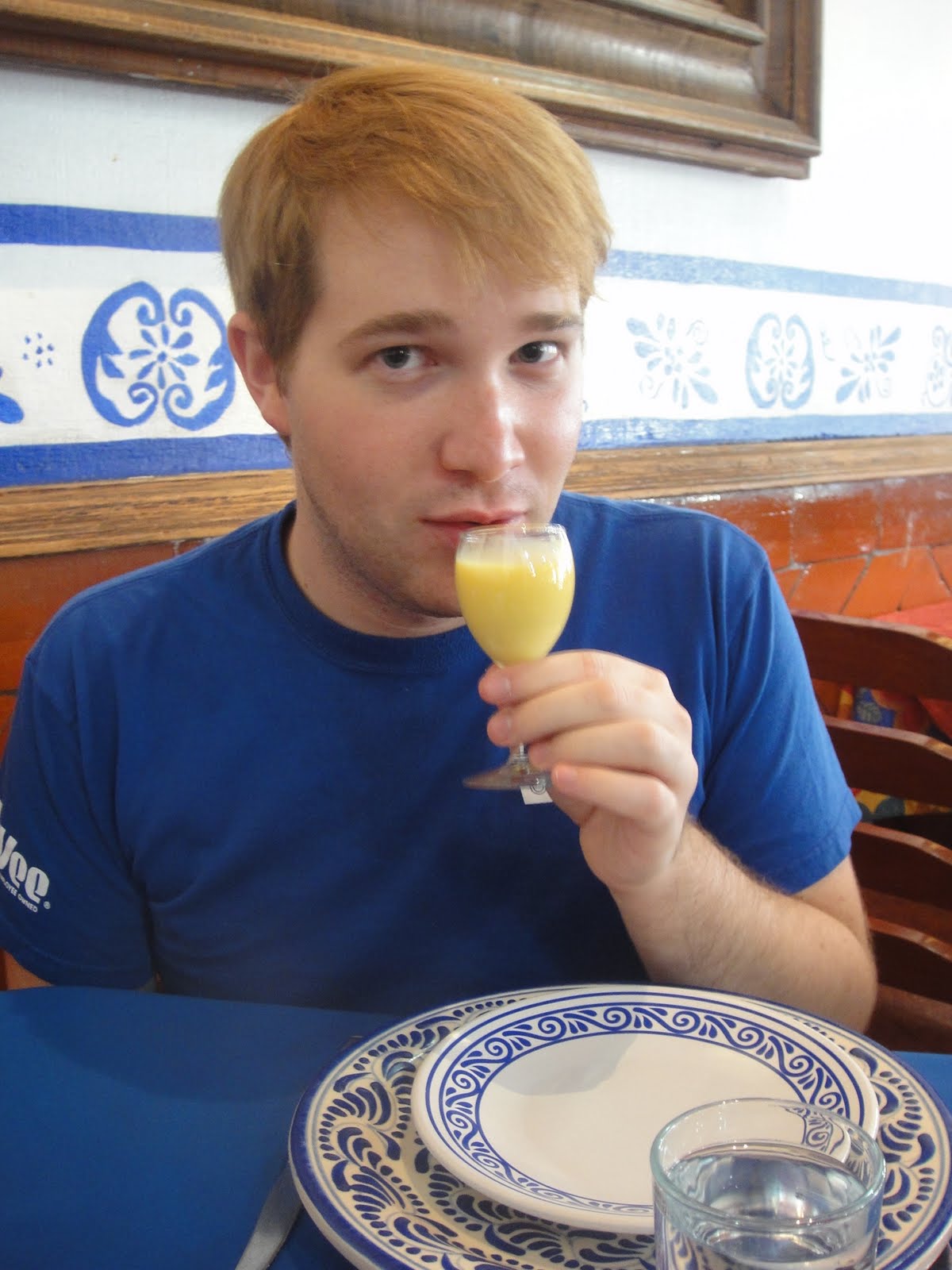
  I also had Rompope, a thick egg drink laced with alcohol: egg nog. It was egg nog without the nutmeg. It is sipped as a cordial all year long.


 I also ordered something that ended in "atole," which is usually a drink made with water and corn and then flavored with other ingredients. This one had squash blossom and chile. I was very interested to see and taste this atole, however it came in a soup bowl with half an ear of white corn. It was good, but not exactly the thurst quencher I thought it was.

 After Jonathan and I both sat back and sighed at the same time, I knew our traditional Pueblan meal was over.

We walked a few blocks to candy street for dessert. Candy street, or 6 Oriente, it's city street name, is lined with candy shops. Signs for dulces tipicos redunantly hang over each shop. Some of them were started by nuns over a hundred years ago. Many of the candies were also created by the nuns in Puebla.

Standing in the middle of Candy Street.

This woman was delivering marzipan roosters to one of the shops. Brightly colored marzipan animals are a common confection all over Mexico, but in Puebla, I only saw roosters.

Aside from the cartoonish aspects, they look like a group of real chickens looking every which way, don't they?

They were so adorable! I had to have one... or three...

Tortitas de Santa Clara: my favorite treat.

stacks of cookies and confections inside a shop


Sugar skulls! These are usually only seen around Day of the Dead in November, but I'm glad this shop sells them out of season.


These are little "cakes" of compressed, finely ground peanut. They look solid, but once you bite into them, they dissentigrate. Maybe that is part of the fun; they are really good though.

These are brightly colored wafer cookies. They also come shaped and decorated to look like all the popular cartoon characters.
My Sweet Mexico has recipes for many, almost all of these confections. On the advice of Chef and author of the book, Fany Gerson, I stopped at a tiny bar I had walked by many times on my trips to the weekend markets: La Pasita. There, they serve a drink by the same name that is thier specialty. It is a raisin liquer served in a shot glass with a cube of salty cheese and a raisin on a tooth pick.


First, you bite the cheese and drink the sweet liquer.

Today was as good an ending to my stay in Puebla as I could have wished for. I lunched on traditonal cusine and gorged myself on sugar candies until my teeth hurt.

Thursday, May 5, 2011

Cinco de Mayo Explained, for Americans

This post is directed at my American readers:
Many Americans celebrate Cinco de Mayo, infact, it might be a fair statement that more Americans celebrate Cinco de Mayo than Mexicans. Do any of them know what they are celebrating? If you guessed Mexican indepenace, you're wrong. Don't feel bad, even many Mexicans don't know the origin of Cinco de Mayo and they certainly don't celebrate it. That is because it is a very regional holiday. The region: the city of Puebla, Puebla, Mexico.

So put down your Taco Bell and American "tacos" of ground beef flavored from a 50 cent packet from the grocery store, and pause your games of flip cup or beer pong with Corona to take time to read this post; so that you may actually toast the true heros of the day, before chugging another beer.

Remember for a second, the war of 1812: The United States was a young country, settled into its independance and busy becoming a great nation. The English, however, hadn't given up, they came back for more! We Yankees eventually kicked thier sorry red coats back to England, but not before they burned the White House and much of Washington D.C. to the ground.

Now, imagine that half way to Washington D.C., an out-numbered militia of poorly armed citizens defeated the "Red Coats" and effectively stopped the invasion of the young, independant country. Sounds great right? Well that is what happened on the 5th of May, 1862 just out side of Puebla, Mexico.

Mexico had already fought for independance from Spain and fought a civil war, leaving a fragile government, deeply indebted to France, Spain, and England. Napoleaon III, Emporor of France and grand son of Napoleon Bonapart decided to take action to secure France's interests. Apparently, the plan was to install a Frenchman as head of the Mexican government.

After landing in and conquering the port of Veracruz, the French started marching towards the capital, Mexico City. Between Veracruz and Mexico City, lies the city of Puebla. 4,500 poor civilians faced the 6,500 French troops and defeated them. Unfortuneatly, this did not end the invasion, but it weakened the French enough that the invasion eventually failed. The victory remains a cause for celebration in the city of Puebla, and unfortunaly, misunderstood by the rest of the world. 

This morning I awoke very early to find a good spot on the parade route. I was ultimately rewarded for my loss of sleep. President Calderon, the president of Mexico was in attendace and I was blessed with a brief glimpse as he arrived in his motorcade of black SUVs. (unfortunaly, I don't have a picture) The parade opened with a large and impressive display of every branch of the Mexican military, which was greeted with shouts of praise and cheers of "Vive Mexico!"
After the military, the parade disentegrated into an extremely long chain of public school marching bands, only interupted by ramdon floats promoting Pueblan culture.


And finally, the parade finished with a lot men and women on horses.


Thursday, April 28, 2011

You Call That A Wedding Cake?!

On the eve of Prince William and Kate Middleton's Royal wedding, speculation and rumors abound about every detail, especially the cake. A few details have already been released: it will be a very traditional fruit cake covered in marzipan and royal icing. The colors will be white and cream and the flowers will consist of the English Tudor Rose, the Welsh Daffodil, the Scotish Thistle, and the Irish Shamrock.

Being the traditional type of British wedding cake, Princess Diana had the same. As far as the flowers, Kate is being rather preferential towards the home countries; Queen Elizabeth II's own wedding dress was embroidered with the national flower of each country over which she reigns.

Some of you non bakers and wedding cake decoraters might be puzzled as to why the British cover an unpopular Christmas cake in marzipan and royal icing and serve it at thier weddings. Its origins were practical and several hundred years later it is tradition. An even older tradition is a tall stack of cakes and as any cake decorator will tell you, cakes don't naturally want to stay ontop of eachother, they sink into eachother. The solution: sturdy building materials, i.e. fruit cake, which is just about the sturdiest cake around. The dense cake provides a solid base that will not be crushed by the tower of cake it supports.

Ever hear of the tradition of the newly weds keeping the top tier for thier first anniversary? Well, originally, they kept it for thier first child's christening. Either way, anniversary or christening, without refrigeration you can't keep a cake past the honeymoon. Enter the fruit cake, which we all know will be the cockroach's only food supply after a nuclear halocaust, as the anti-fruit cake joke goes...

While America's distaste for fruit cake is still prevelant, many are getting into the act, by serving it at parties while watching the wedding on telvision. Personally, I have always been a big fan of the dense cake laced with alcohol and spotted with dried fruit gems.

The future King and Queen of a quarter of the world's population, otherwise known as the Commonwealth Realm may be having a very traditional fruit cake, which might still boggle your mind, but consider some other traditional baked goods served at weddings around the world and fruit cake may not seem so out of place or even out of season. In fact, many of the cakes served at weddings are the same cakes served at all special occasions, especially Christmas.

Centuries old rivals and often times subjects to the English crown, the French have thier own traditional wedding cake. It is called a croquembouch, meaning crack in the mouth. It consists of profiteroles, or cream puffs dipped in caramel and stacked into a tall cone and wrapped in spun sugar.

The tall cone shape is continued by the northernly Scandanavians and the Danes with the kransekake, or ring cake. It consists of consentrict circles of an almond sponge cake stacked on top of each other and held together with icing. It is another all purpose special occaision cake, particularly Christmas.

Throughout Central Europe, many countries have a variation of a cake that is baked, more or less on a spit or in a rotissery type oven. The Germans call it Baumkuchen, or "tree cake" because when you cut it open it looks like the rings of a tree. The Baltic country of Lithuania has, I think, the most striking version which they also refer to as a tree cake or Ĺ akotis whichy means "branchy."


A plain Ĺ akotis.


A Ĺ akotis decorated as a modern wedding cake with sugar roses and swans.


A traditional Ĺ akotis rotissery oven.
In the Slavic countries of Russia, Poland, and the Ukraine the traditional wedding treat is an oranamental bread called korovai.  Though it has no specific design and varies by region, it is heavily deocrated with birds, periwinkles and other flowers, the moon, and wheat sheaths all to symbolize love, prosperity, purity, and the happiness of the couple.
Western style sweets of all kinds, including wedding cakes have been creeping into Asian cultures for many years now. However, traditional Asian "sweets" are rarely sweet. They mostly consist of red bean paste, rice, and sometimes a sugar cane juice similar to molasses. Here is a short video of making traditional Chinese wedding rice cakes.


In comparison, a wedding fruit cake doesn't seem so different after all, does it?

UPDATE: 4/29/11
Here is the actual fruit cake that William &Kate served at thier reception.

Monday, April 25, 2011

Eggcellent Eggs

I know, I've really slacked off on the blogging thing. I have six half finished, incoherent, rambling posts saved in my draft box and I figured it was time to reduce that number to five. This post has remained unfinished for over a month because the subject is so vast, it seemed impossible to comprehensively cover. This subject is: The Egg.
In "On Food and Cooking," Harold Magee dedicated the second chapter to eggs in no less than 50 pages; I'll try to be more brief. Yet I cannot deny that as a pastry chef and baker, eggs are an invaluable ingredient. The number of ways an egg can be transformed are innumerable: they are the building blocks of cakes and cookies, as well as make a rich, dense custard, or an airy, smooth meringue of whites whipped with sugar, and even provide that beautiful brown glossy crust on anything baked.

Traditional chef head gear: the toque is supossed to have 100 folds to represent the 100 different ways to cook an egg.

 As a consumer of food, I cannot deny that eggs are orgasmic. (when prepared correctly) I like my scrambled eggs and all yolks runny, I like eggs cooked in butter and I especially like them coated in a sauce made from more yolks and butter. I whole heartily support Wylie Dufresne, chef of wd-50 in New York City who is a self proclaimed "egg slut." He is so obsessed with eggs, he revealed his true political leanings when he said "Eggs Benedict is genius. It’s eggs covered in eggs. I mean, come on, that person should be the president.”


My love of egg yolks, runny or other wise, is a complete reversal from my childhood when I only liked egg whites. I ignored the yolks and only occasionally gritted my teeth and chewed through the chalky hard cooked yolk. However, now, I cannot get enough yolk. Literally, I have to crack a few eggs to collect enough yolks. Only occasionaly and always unexpectedly, do I crack open a double yolker. Of course, I let out a cheer of surprise and thanks to a hen for the gift. Everyone gets excited when they open a double yolker.

There is a family farm here in Puebla, Mexico who takes all of that surprise away. They candle all of their eggs after they are collected and separate the double yolkers. The eggs are sold to the woman I buy eggs from at the market who is able to offer, probably the most unique product at the market. (This is the reason I LOVE markets! Commercial egg producers won't take the time and effort to market double yolkers.)
 These eggs are HUGE, I mean bigger than extra large or jumbo eggs in the United States.


 Two kilos, which is usually between 30-32 eggs, costs 33 pesos which at the exchange rate I paid, equals $2.82. We go through them in a week.

Sunday, April 24, 2011

My Easter Story: Oma and the Pope

Happy Easter!
I spent all week in Acapulco celebrating my  birthday and spring break with Jonathan's family.  We returned to Puebla in the early morning. So my Easter was pretty low key, Jonathan and I went out for sushi.
I thought I would share a more exciting Easter story: my Easter in Rome with my Oma.
Like I have said before, in the spring of 2009 I spent almost 2 months traveling through Italy and Germany with my 90 year old grandma, whom I call Oma. We landed in Rome at 6:50am on Easter morning with no plans or reservations. It had been a long overnight flight in which Oma picked a fight with every cryying baby, their mothers and the head flight attendant; but that is a separate story.

After we collected our luggage, we were standing in the middle of the terminal, free to explore Italy. Dumbly, I flipped through my copy "Traveling through Italy for Dummies" as if some new tip appeared since I had put it away for landing. My hands began shaking as the realization that I had just traveled across the Atlantic with a mostly deaf, 90 year old woman with no itinerary. In a daze, I put the book away and found a hotel service with Oma and our bags in tow.

 "Do you speak English?" I asked the attractive young woman behind the counter.
"ah, no" she replied. Oma started telling the woman her life story and the reason for our trip, as she was apt to do. In English.
 "Speak Italian," I told Oma and in a blink of an eye, a torrent of Italian was unleashed. After several minutes, the young Italian woman turned to me and said "she reminds me of my nonna. Now, this is the only room I have for you and your nonna. It is very nice, in the center of the city. It is only 190 Euro." (which is double what we were expecting, but when you show up in Rome on Easter, beggers can't be choosers.)
So Oma paid a deposit on the room and our shuttle directly to the hotel.
We had a pleasant drive into the city with a very chatty driver. I discovered that I understood Italian very well without any formal Italian lessons at the time. The driver dropped us off at the hotel door and wished us a happy Easter.
"Buon Giorno e Buona Pasqua," the man behind the desk greeted us. Oma responded by asking when the Pope was giving Easter mass. [That was her only desire all along. Even though she lived in Rome for 13 years prior and during  the war and had a brother studying at the vatican to become a priest, so has already seen more private inner workings of the vatican than most people, she had never been to an Easter mass with the pope.]
The man behind the desk told us that mass would begin in under an hour and we should leave right away. He would take care of our luggage and we could finish checking in when we returned. Personaly, I wanted to at least change out of the jeans and sweater I had been wearing for 24 hours, but Oma had already run out of the hotel onto the street like she knew where she was going. Tha man behind the counter quickly circled the location of the hotel on a tourist map and showed me where the train and bus station was three blocks away. He meantioned something about a bus number as I ran out the door to chase down Oma. I didn't hear it.

I caught up to Oma running up the street and she asked me which way to go...  After a few twists and turns we found the buses and were confronted with the ticket system. Fortunatly, there was a british couple at the ticket machine in front of us. Unfortunaly, they were not eager to help me. The wife dryly told me to put money in and push a button as she walked away. I rolled my eyes and fiddled for a minute and finally figured out how to get two tickets. I also happened to see a sign that read "vaticano." We stood in line for a bus. When it arrived, everyone pushed, shoved and packed into it. I made it to third base with half the people on that bus.

Finally it stopped on an empty street and everyone poured out. "This must be it" I thought to myself. I grabbed Oma's arm and we got off the bus. Half the crowd went left and the half went right. I followed the right half around a corner and we walked right into a line leading directly into St. Peter's square.

Oma impatiently ducked, weaved, and cut her way through line leaving me scrambling after her. Through the metal detectors I found my self standing at the very front left corner of St. Peter's square.

Oma and I made our way to the front of the crowd, as close as the general public could get, and I could see the Pope with my own eyes.


The millions of people behind us.
At one point a crowd of Sudtirolers surrounded us and Oma's day was made!

At anotherpoint, I don't know how many hours into the mass it was, an Italian woman grabbed Oma's arms and supported her.( It was my first day on the job, I still didn't know how to take care of a 90 year old woman.) The woman turned out to be a tour guide who brought her group to the mass. She talked with Oma and held her arm the whole time. At one point Oma joined the Pope in singing the mass and the woman looked at me agast and asked "Your grandmother speaks Latin?!" "yeah, she studied it in university" I replied.
People came and went, but Oma and I stood through the entire mass and blessings afterward. St. Peter's square emptied in a second when it was all over.

After mass the Pope went out on his balcony and blessed the crowd.
Oma and I followed the crowd walking along the Tiber River until we found a little cafe that
 did not look packed. We each had a simple panini and a bottle of water. Then we walked back to St. Peter's to go inside the cathedral. The square had again filled with a rediculous line coiled around the square. I scanned the scene thinking that there was no way Oma could wait in this line, and just as I turned to ask her what she thought we should do, she collapsed face down.
I immeadiatly picked her up but she doubled over again grabbing her left leg. A vatican guard came running over to check on us. I tried to convince Oma that we should just go to the hotel, but she refused to leave. She massaged her cramped leg until she could stand on it again and the guard walked us to the front of the line. (Sometimes traveling with a 90 year old woman pays off.) We walked around and Oma told me stories of her brother and some history of the Catholic church.
Walking up to St. Peter's
Standing directly under neath the Pope's balcony.

Oma inside St. Peter's.
When we left St. Peter's I was more than ready to go back to the hotel but Oma insisted on walking to the Piazza del Poppolo like she used to with her brother. I was getting worn out and confused. My brian stopped functioning and I just hopped on the first bus, luckily, it was going to the station. However, my luck ended there. When we got to the station I realized that we ran out of the hotel so fast I didn't even catch the name. All I had was a circle on a map which I couldn't make heads or tails of. We stumbled around in circles knowing that we were close the the hotel but I couldn't for the life of me remember the name. Finally I started walking in hotels asking for help to figure out which hotel was mine. After a few indignant desk clerks, we figured out in which hotel we were staying.
I asked for a cab, cause I knew I would screw it up. Oma and I took a cab one block around the corner to our hotel: Hotel Virgili.

There was a different man at the desk, but he knew who we were. We needed to pay for the other half of our hotel room, which I knew, but Oma thought she paid for in full at the airport. I tried to convince her, but she refused to believe me. In my tiredness, I could not find the reciept, which only comfirmed to Oma that she paid in full. I was too tired to fight so I threw my ccredit card down to cover the rest of the room.

Oma started screaming bloody murder in the lobby. "You can't trust Italians! You don't know them! They lie! They cheat! They steal! They'll rob you blind! Italians are the dirtiest, cheatiest people in Europe!" Her tirade continued as I marched up the stairs. By the time we reached our room on the fifth floor she had worn out, but as soon as I opened the door, she got a second wind.

Our room was a very handsome room with green and gold wallpaper, tall ceilings, a double bed, a desk,chair and our own comfortable bathroom. Unfortunatly it was all squeezed into a tiny room so that you actually could not walk in the room. You had to crawl over the desk in the narrow hallway to get to the bed which had part of our luggage sitting on it because there was not enough floor space. Oma complained and lamented how I let us get cheated and taken advantage of, but I didn't care. I laid down on the bed in my clothes and passed out as soon as my head hit the pillow. The last thing I saw was the tiny mint on my pillow.

I awoke in the middle of the night overwhelmed by the obnoxious scent of mint and all I could think was "Oma do you have to eat that now?!"  I rolled over to see Oma applying mint Bengay to her legs. I became very familiar with that smell over a month and a half.

Tuesday, March 1, 2011

I'm at War with the Sun, Please Send Sh[AID]

To my faithful readers, (both of you) I'm sorry it has been more than a week since my last post. Our internet has been unsteady and when it has been steady, my motivation has been low. Fortunatly, both have returned with strength.
Hot, full searing sun, and blowing wind  cause quick water evaporation; sounds like the perfect spot for a garden right? Well, thats where my new garden is located: on the roof. As my skin and future oncologist I'm sure will tell you, too much sun is bad! I've had some blistering, searing sun burns in my life, but the last time I was in Mexico, two years ago, I got sun poisining. While sunning myself on the same roof, I absorbed too much sun. It was painful in every sense of the word; I was cooked well done.  Two years later, I haven't learned any better... My skin is fine (for now), I bathe in lotion more than I do water. The lesson I have not learned is that the climate on the roof is intense!

Naively, I assumed the strong, full sun would be a boon to my seeds as they sprouted and grew. It wasn't. The sun and wind took the water as fast as I poured it out. Accepting defeit, I carried all of the egg cartons containing planted seeds down to the narrow courtyard that spans the back of the house. The courtyard gets about 15 minutes of direct sun in the afternoon as the sun streaks across the sky. The rest of the day, it stays cool in the 50's and 60's. Neither are ideal: the roof is way too hot and the courtyard is shaded and cool. The courtyard being less extreme, I left the seeds there for a week and nothing grew. I became impatient.

 A light bulb flashed over head and I chided myself for not thinking of it sooner: place the egg cartons in the big plastic bags the soil came in and place them on the roof. It was the perfect solution to my water problem. Within and hour on the roof, tiny green dots appeared on the surface of the soil. I vented the bag and went for shelter inside the house. Mid afternoon I returned to roof to check on my plants which I was smuggly sure had already out-grown the bag. They were dead; the green dots were all brown.

In shock and disbelief, I quickly moved all of the cartons to the small patch of roof shaded by the water tank in the afternoon. I angrily dared all of the seeds to be dead and cursed the sun and my stupidity.
For a few days it was difficult to get out of bed. I grieved the death of my garden, but stubbornly climbed up to the roof to look at egg cartons full of dirt in a plastic bag. Everyday, I vented the bag and sprinkled water inside like someting would grow. I prayed for just one seed to sprout. Just one, I would be happy with any plant to tend.

Then, yesterday, a miracle. I noticed a green dot and opened the bag as eagerly as a child shredding wrapping paper at Christmas. I pulled out each egg carton and placed my eye directly on the soil to inspect it. The green dot I saw was an herb, my guess is basil. But there were more! At least a dozen microscopic green herb shoots just breaking the soil. I was elated, but nothing compared to the feeling of my heart stopping for a second and then beating twice as fast when I saw one sprout each of the two tomato varieties I planted. One by one, each carton surprised me with at least one seedling of each vegetable I planted.

Stubborn perservearance paid off, I narrowly won the first battle. However, the war has just begun. The sun will get stronger as we move into summer and (hopefully) my plants should grow too big to live in the shadow of the water tank. I am already devising a battle plan for keeping the young plants alive: bring it on sun...