To complete any task, it is much easier to have all of the necessary equipment and materials ready and waiting to be used. Chefs call this "mise en place," a French term that literally means "put in place." This step is crucial in the kitchen where the next move is always only seconds away. If chefs fail to plan for the next step, their movements are disjointed and inefficient, delaying your meal.
Like many chefs, I apply "mise en place" to everything I do, including and especially traveling. Where unlike in a kitchen, when prep time ends and service begins, it is possible, however rushed, frantic and frustrated it makes the entire kitchen, to make more prep; however, once you have left home, anything you forgot is unavailable until you return.
Arriving at the airport and realizing you forgot your passport or getting sick on vacation and not having your own medicine waiting in your bag will definitely spoil the trip. Because depending on where you are traveling, the cultural views of medicine could be very different from your own and you don't want to be relying on suspect remedies. Once, I got sun poising in Mexico and could not find a soothing sun lotion or even aloe lotion to save my life. The pharmacist gave me a lotion that burned and only made my symptoms feel worse. I had to butcher a neighbor's aloe plant (which puzzled my Mexican friends because they don't seem to use aloe for burns) and sleep with bags of frozen vegetables to find any relief.
I consider myself an experienced traveler and these "mise en place" practices have never failed to make a successful trip:
A Baggage Scale
This was a birthday gift from my mom last year, and a great gift at that! You simply clip the strap around the handle of your bag and pick up the bag by holding the scale. This scale is digital and reads in pounds and kilos and is also compact so that I can bring it with me to weigh my bags on the trip home. It has become an invaluable tool that takes all of the guess work out of packing checked bags and allows me to pack to the exact weight limit; it has never been wrong. I'm not sure what it costs, but it must pay for itself by avoiding any weight overage charges.
Proper Shoes
It is not uncommon to walk everywhere while traveling and good shoes are critical. This might seem obvious, however, the obvious details are the ones most often overlooked. Sore, or blistered feet will not be overlooked, they will remind you with each step that you forgot to do your "mise en place." My shoes have been up and down Manhattan New York, from Rome to Munich, across China and all over Mexico. They have become tattered and dirty and the souls are separating, but they are great shoes! After I replaced the lining with Dr. Scholls inserts they were like new again. I love these shoes, but I fear they may have seen their last trip.
Passport with my Toiletries
It might seem odd, but my passport is always in my toiletries bag. I joke that in case I ever need to escape the country, I can make a quick get away. However, the real reason is practical and speaks to my itinerant nature. I move so often, that my belongings rarely stay in the same place long and become misplaced in new locations. My toiletries are among the few things that I ALWAYS have with me. It is convenient because whenever I travel I need my toothbrush, toothpaste, deodorant... and my passport.
Carry Ons
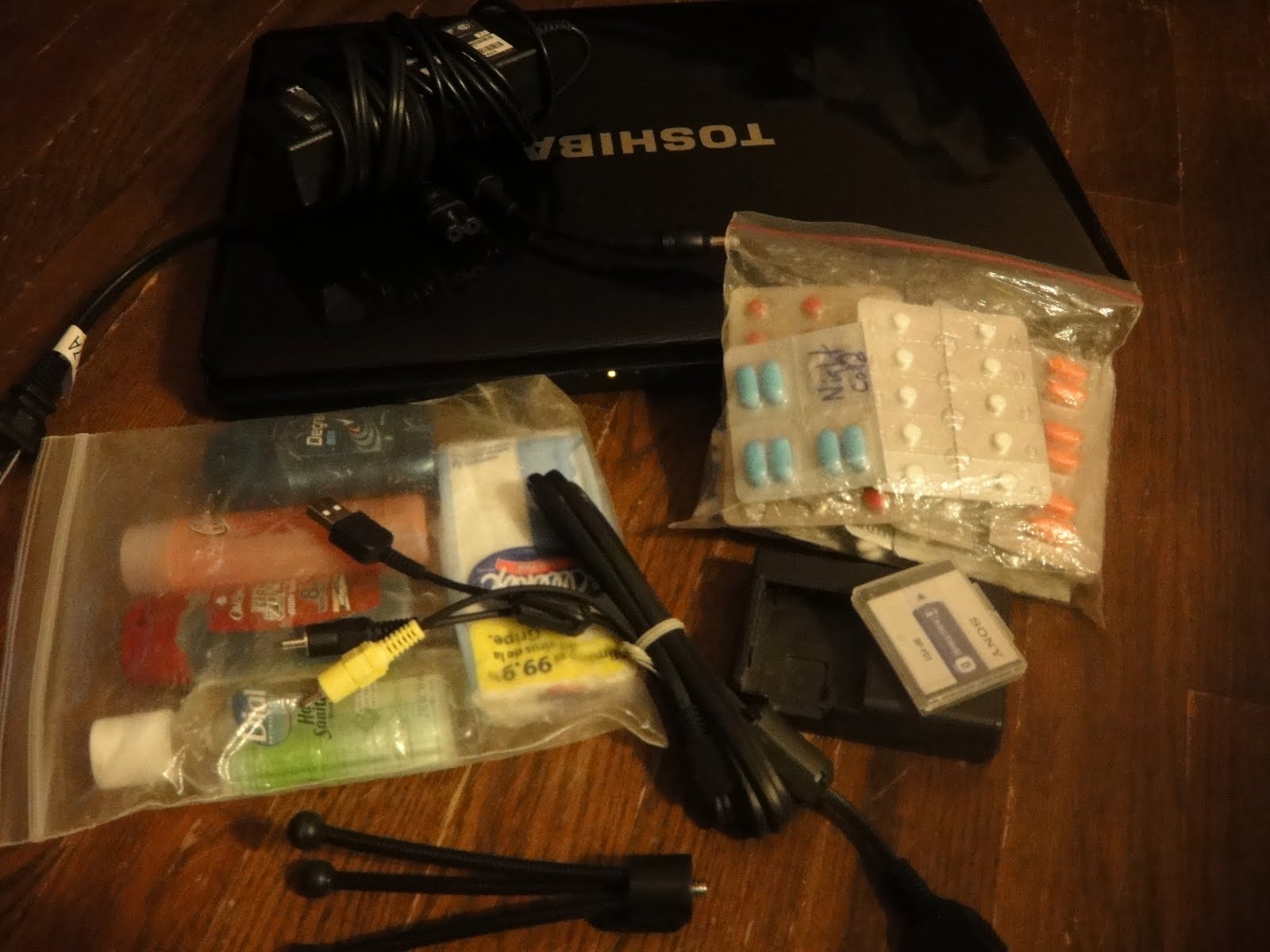
For better or worse, the regulations regarding carry on baggage seem like they are always changing. However, my carry on items remain the same: I bring a back-pack that I have had for many years and a small blue duffel bag that I have had for even longer. The back-pack contains my camera and accessories, my laptop, a folder containing all of my travel information and anything small, fragile or valuable. The duffel bag contains my laptop's power cord(because it is too bulky to go in the back pack), a sandwich baggie of travel size toiletries, a variety of pills for a variety of symptoms, a change of clothes (every time I do not follow this rule, I get stranded somewhere or my baggage gets temporarily lost and I actually need a change of clothes), and coming home it is full of heavy souvenirs.
Packing Patterns
Like any experienced line cook, who can look at their station and see what is out of place or missing, I travel so often that I have developed packing patterns. These patterns come from using the same luggage on every trip and they help me notice missing or out of place items.
Whether you are making a meal or packing for vacation, remember to do your "mise en place!"
Friday, May 27, 2011
Tuesday, May 24, 2011
Top 10 Reasons to Miss Mexico, #5- #1
#5: Markets
Forgive me for being repetitive, I know I have expressed my love for markets many times here. I absolutely love the freedom they give shoppers who are free to comparison shop for the best quality, best prices and even find unique products like all double yolk eggs. Markets exist in the U.S., but they are the alternative means of shopping and heavily regulated, which is done in the name of public safety and sanitation. Malarkey!
#4: Sapote Fruits
There are a multitude of distantly related and unrelated fruits that carry the name "sapote." Here in meat and potato country we have a saying: "I've never met a potato I didn't like;" I can now confidently apply the phrase to sapote fruits as well.
Sapote fruits, related to the plant family sapotaceae or not, do seem to have a few key similar characteristics:
All fruits grow on large trees throughout the world's tropics, all sapote fruits are desserts in themselves, no sugar added, all sapotes become nearly mush when they are ready to eat (which would be why they're not available in your super market), and all sapotes have large seeds which are toxic if ingested.
#3: Tacos
I will start by making clear that ground beef tacos, seasoned with a packet from the grocery store piled with yellow cheese, lettuce, tomatoes, and chunky salsa is not Mexican.
So what are real Mexican tacos? well, they're kind of like classical French sauces, they're all made from the same components, but there are a lot of regional differences and if you change one ingredient, it gets a new name.
Also, depending on the type of taco you order and where you are ordering them, you may order a certain number of tacos or you may order the taco meat by weight and then you get all the fixin's. The fixin's will vary, but you will always squeeze lime juice over it and add either red or green salsa. Then tear the tortilla in half or quarters and pinch a bit of meat between the tortilla with your hands and there you have your taco.
#2: People Selling Goods on the Street
For all the problems Mexico has, in a few ways, Mexicans are more free than Americans. (don't tell Jonathan I said that, this topic caused many debates) They truly have a free market capitalist economy. People are free to sell, pander goods, and perform their talents for money as they see fit.
Enterprising Mexicans are free to set up a grill and sell food on the sidewalk, or walk around with a basket of goodies. They can also stand on the street and act as parking attendants, directing you to a good spot, and for a few pesos they will wash your car while you're away. At stop lights, jugglers, fire breathers, slit walkers and clowns entertain while others pander candy and flowers. Several times, I saw an individual with a bucket of paint, painting yellow stripes on speed bumps collecting change as people passed, of course they use water based paint so that they can come back in a few weeks and paint the stripes again. These were just ordinary citizens trying to earn money.
There are also plenty of people who sell real, tangible goods by walking them around the street or driving around with speakers on top of their car announcing what they are selling. Need a queen size bed frame? or dinning room table set? There are men who walk the streets pushing a cart carrying them, I swear! Music is a great attention getter. Once I saw two men pushing a very large xylophone for sale down the street and playing it the whole way. Then there was always the gas truck:
I'm not saying that these are jobs Americans should aspire to, or that drug cartels aren't giving poor people a shake down for money earned. Maybe the government is simply too busy to worry about how its citizens make and honest living, but can you imagine trying to do any of those things in the U.S.? Someone would call the cops! Then you'd be shut down and saddled with a fine for not having a permit or you could be arrested, or worse, sued! Is that freedom America? Nobody forces you to eat street food, if you think it's unsanitary, then don't eat there, but government should not impede anyone from starting an honest business with rules and regulations.
#1: New Expiriences
The thing I will miss most about Mexico is the fact everyday I saw or learned something that I had no idea existed. I miss the adventure involved in everyday tasks. The truth is that Mexicans and the whole world do not live the same lifestyle we do. I like some of their customs better, and I like some American customs better, but what I like most of all is learning about all of the customs and ways of life.
| How do you buy your meat? Do you watch your butcher cut into whole sides of freshly butchered animals for the cut of meat you want? |
| Fruits and vegetables are stacked into impossibly high walls at every stall. |
#4: Sapote Fruits
| Mamey Sapote: I think it has the sweet flavor of squash in a fruit with the texture of avocado. |
There are a multitude of distantly related and unrelated fruits that carry the name "sapote." Here in meat and potato country we have a saying: "I've never met a potato I didn't like;" I can now confidently apply the phrase to sapote fruits as well.
Sapote fruits, related to the plant family sapotaceae or not, do seem to have a few key similar characteristics:
All fruits grow on large trees throughout the world's tropics, all sapote fruits are desserts in themselves, no sugar added, all sapotes become nearly mush when they are ready to eat (which would be why they're not available in your super market), and all sapotes have large seeds which are toxic if ingested.
#3: Tacos
I will start by making clear that ground beef tacos, seasoned with a packet from the grocery store piled with yellow cheese, lettuce, tomatoes, and chunky salsa is not Mexican.
So what are real Mexican tacos? well, they're kind of like classical French sauces, they're all made from the same components, but there are a lot of regional differences and if you change one ingredient, it gets a new name.
Also, depending on the type of taco you order and where you are ordering them, you may order a certain number of tacos or you may order the taco meat by weight and then you get all the fixin's. The fixin's will vary, but you will always squeeze lime juice over it and add either red or green salsa. Then tear the tortilla in half or quarters and pinch a bit of meat between the tortilla with your hands and there you have your taco.
#2: People Selling Goods on the Street
| I never fail to be amazed by the amount of food that is able to be stored, cooked and served on a card table and portable flat top grill on a sidewalk. |
For all the problems Mexico has, in a few ways, Mexicans are more free than Americans. (don't tell Jonathan I said that, this topic caused many debates) They truly have a free market capitalist economy. People are free to sell, pander goods, and perform their talents for money as they see fit.
Enterprising Mexicans are free to set up a grill and sell food on the sidewalk, or walk around with a basket of goodies. They can also stand on the street and act as parking attendants, directing you to a good spot, and for a few pesos they will wash your car while you're away. At stop lights, jugglers, fire breathers, slit walkers and clowns entertain while others pander candy and flowers. Several times, I saw an individual with a bucket of paint, painting yellow stripes on speed bumps collecting change as people passed, of course they use water based paint so that they can come back in a few weeks and paint the stripes again. These were just ordinary citizens trying to earn money.
There are also plenty of people who sell real, tangible goods by walking them around the street or driving around with speakers on top of their car announcing what they are selling. Need a queen size bed frame? or dinning room table set? There are men who walk the streets pushing a cart carrying them, I swear! Music is a great attention getter. Once I saw two men pushing a very large xylophone for sale down the street and playing it the whole way. Then there was always the gas truck:
I'm not saying that these are jobs Americans should aspire to, or that drug cartels aren't giving poor people a shake down for money earned. Maybe the government is simply too busy to worry about how its citizens make and honest living, but can you imagine trying to do any of those things in the U.S.? Someone would call the cops! Then you'd be shut down and saddled with a fine for not having a permit or you could be arrested, or worse, sued! Is that freedom America? Nobody forces you to eat street food, if you think it's unsanitary, then don't eat there, but government should not impede anyone from starting an honest business with rules and regulations.
#1: New Expiriences
| I looked too gringo eating with a fork and knife, so I switched to eating my traditional Mole with a tortilla, the Mexican utensil. |
Monday, May 23, 2011
Top 10 Reasons to Miss Mexico, #10- #6
I have been home, in the United Sates for a week now, actively looking for a job as well as cleaning out my bedroom of things from high school and college. I am already pretty settled into my new routine at my mother's house. However, there has been one thing nagging in the back of my mind: the draft box in my blogger account. It is full of fragmented posts about Mexico that I couldn't seem to type more than a few sentences about. So, in my determination to put everything from the past, including Mexico, behind me, I am mashing them all together into a "top 10 things I miss about Mexico" list.
#10: Cheap Beer
Mexico is not the beer guzzling nation that the United States is, it has five or six national brands of beer and it's all light and easy to drink. However, what Mexican beer lacks in flavor and body, it makes up with unique preparations and cost. By "unique preparations," I mean that you can enjoy your beer with lime, chile and/or a salted rim.(refer to #6) The cost is cheap, cheap, cheap. I once went out with 30 something Pesos in my pocket (a little over $2 U.S.) and bought 1.5 liters of beer for me and two wine coolers for Jonathan and had change when I got home.
#9: the Sun and Heat
Back in February, when I was packing, and it was negative something outside, I could not imagine that it wasn't still just a little bit cold in Mexico. With that logic, I packed a jacket and a few sweaters. I wore the thinnest sweater a few times after the sun went down, but the rest remained untouched from the time I unpacked them to the time I repacked them. Many times it was too hot for clothes, let alone a sweater!
Full of hope and assumption that summer was in full swing, I returned home ready to finally put the sweaters away for the rest of the year.
Nope. The high in Kansas City the day I returned was 69, near freezing temperatures by my count. Instead of putting sweaters away, I was pulling more out. I could not keep warm enough.
Now, I yearn for those consistent, high 80 degree, sweaty days. When will they come to Kansas City?
#8: Vibrant House Colors
Here, in the mid-west, whole neighborhoods are built where every fifth house has the same design and they are all a shade of white or beige. But color is everywhere in Mexico. Houses, buildings, and interior wall colors are bright, varied and as different from one another as apples and oranges. It is not uncommon to see a row of buildings painted blue, then red, then yellow, then green, making a rainbow of buildings.
#7: Uncontrolled Traffic
Of all the places I have been, the United States has the most regulated traffic. In my home town, in Missouri, drivers could be accused of meandering, slowing down to smell flowers on the side of the road and waving to neighbors and passers by. Even the aggressive, speed demon drivers in New York seem tame compared to the some of the shenanigans I've seen around around the world.
In Mexico there is a certain uncontrolled, free flowing rhythm to traffic: pedestrians cross the streets as they please, drivers whizz through lanes and create new ones. Buses are as ubiquitous as taxis and even though there are a few designated bus stops, you can flag one down and hop on anywhere and then be let off anytime you please, including on the high way. There are traffic laws, but they seem to go ignored as life carries on.
#6: Everything is seasoned with Chile and Limon
In most Western cuisine, seasoning is limited to salt and black pepper. They are part of a proper table setting as much as plates and flatware. Without them, a table feels incomplete and many Americans could not enjoy a meal without these crucial seasonings.
For a long time, I could not understand why my Mexican room mates HAD to have cream(similar to, but totally different from our sour cream), "limon" (Mexican, or Key lime)wedges (Our yellow lemons are rare and unheard of to most Mexicans.), and a salsa on the table during a meal. Even if I had already seasoned the food with these flavors they would go get it and put more on their plate. Jonathan said the food just felt plain without being able to add his own seasoning. That is the beauty of Mexican food: everyone can personalize their food.
But these seasonings aren't just at the dinner table, they flavor everything from candy to beer. While American children dip candy sticks and suckers into flavored powders ranging from pure sugar to mind blowing sour, Mexican children dip their candy into chile powder with lime flavor.
Michelada is my newest Mexican obsession; it is a beer that has been poured into a glass rimmed with salt and chile powder, combined with lime juice and dusted with small chile flakes.
#10: Cheap Beer
Mexico is not the beer guzzling nation that the United States is, it has five or six national brands of beer and it's all light and easy to drink. However, what Mexican beer lacks in flavor and body, it makes up with unique preparations and cost. By "unique preparations," I mean that you can enjoy your beer with lime, chile and/or a salted rim.(refer to #6) The cost is cheap, cheap, cheap. I once went out with 30 something Pesos in my pocket (a little over $2 U.S.) and bought 1.5 liters of beer for me and two wine coolers for Jonathan and had change when I got home.
#9: the Sun and Heat
![]() |
| It can be difficult to find shelter from the searing sun, especially on the beach. |
Full of hope and assumption that summer was in full swing, I returned home ready to finally put the sweaters away for the rest of the year.
Nope. The high in Kansas City the day I returned was 69, near freezing temperatures by my count. Instead of putting sweaters away, I was pulling more out. I could not keep warm enough.
Now, I yearn for those consistent, high 80 degree, sweaty days. When will they come to Kansas City?
#8: Vibrant House Colors
Here, in the mid-west, whole neighborhoods are built where every fifth house has the same design and they are all a shade of white or beige. But color is everywhere in Mexico. Houses, buildings, and interior wall colors are bright, varied and as different from one another as apples and oranges. It is not uncommon to see a row of buildings painted blue, then red, then yellow, then green, making a rainbow of buildings.
#7: Uncontrolled Traffic
![]() |
| Of all the buses to ride in Mexico, the party buses in Acapulco provide the most interesting ride. |
In Mexico there is a certain uncontrolled, free flowing rhythm to traffic: pedestrians cross the streets as they please, drivers whizz through lanes and create new ones. Buses are as ubiquitous as taxis and even though there are a few designated bus stops, you can flag one down and hop on anywhere and then be let off anytime you please, including on the high way. There are traffic laws, but they seem to go ignored as life carries on.
#6: Everything is seasoned with Chile and Limon
| A whole isle in the Supermarket for dried chiles. |
| Anywhere limon could be added, it has been. |
In most Western cuisine, seasoning is limited to salt and black pepper. They are part of a proper table setting as much as plates and flatware. Without them, a table feels incomplete and many Americans could not enjoy a meal without these crucial seasonings.
For a long time, I could not understand why my Mexican room mates HAD to have cream(similar to, but totally different from our sour cream), "limon" (Mexican, or Key lime)wedges (Our yellow lemons are rare and unheard of to most Mexicans.), and a salsa on the table during a meal. Even if I had already seasoned the food with these flavors they would go get it and put more on their plate. Jonathan said the food just felt plain without being able to add his own seasoning. That is the beauty of Mexican food: everyone can personalize their food.
But these seasonings aren't just at the dinner table, they flavor everything from candy to beer. While American children dip candy sticks and suckers into flavored powders ranging from pure sugar to mind blowing sour, Mexican children dip their candy into chile powder with lime flavor.
Michelada is my newest Mexican obsession; it is a beer that has been poured into a glass rimmed with salt and chile powder, combined with lime juice and dusted with small chile flakes.
Saturday, May 14, 2011
I Gorged on Mole, Cuitlacoche, and Dulces Tipicos
Sadly, I just returned from my last trip to the city center/ Zocalo, weekend Market, and Puebla's famous candy street. I'm returning to the United States tomorrow.
Jonathan and I started out the day by having a huge lunch at la Fonda de Santa Clara, a very old, traditional Mexican restaurant that panders to tourists. It is not hoaky or cheesy, like most Mexican restaurants in the United States, it is simply all things traditionally Pueblan.
The menu contains everything necessary to taste while in Puebla, like a one stop "eat your way through Puebla" deal. There is also a list of seasonal specialties, this month's specialty is an Aztec dish of century worms (that's how it was translated into English) cooked in a chile sauce served with beans and guacamole. Jonathan said it was a delicacy so I was very excited to order it. Unfortunalty, they didn't have it. (How do you not have the monthly special?!?) So I settled for Puebla's most famous dish: Mole. Half way trough my plate, I swapped with Jonathan for his adobo pork and cuitlacoche.
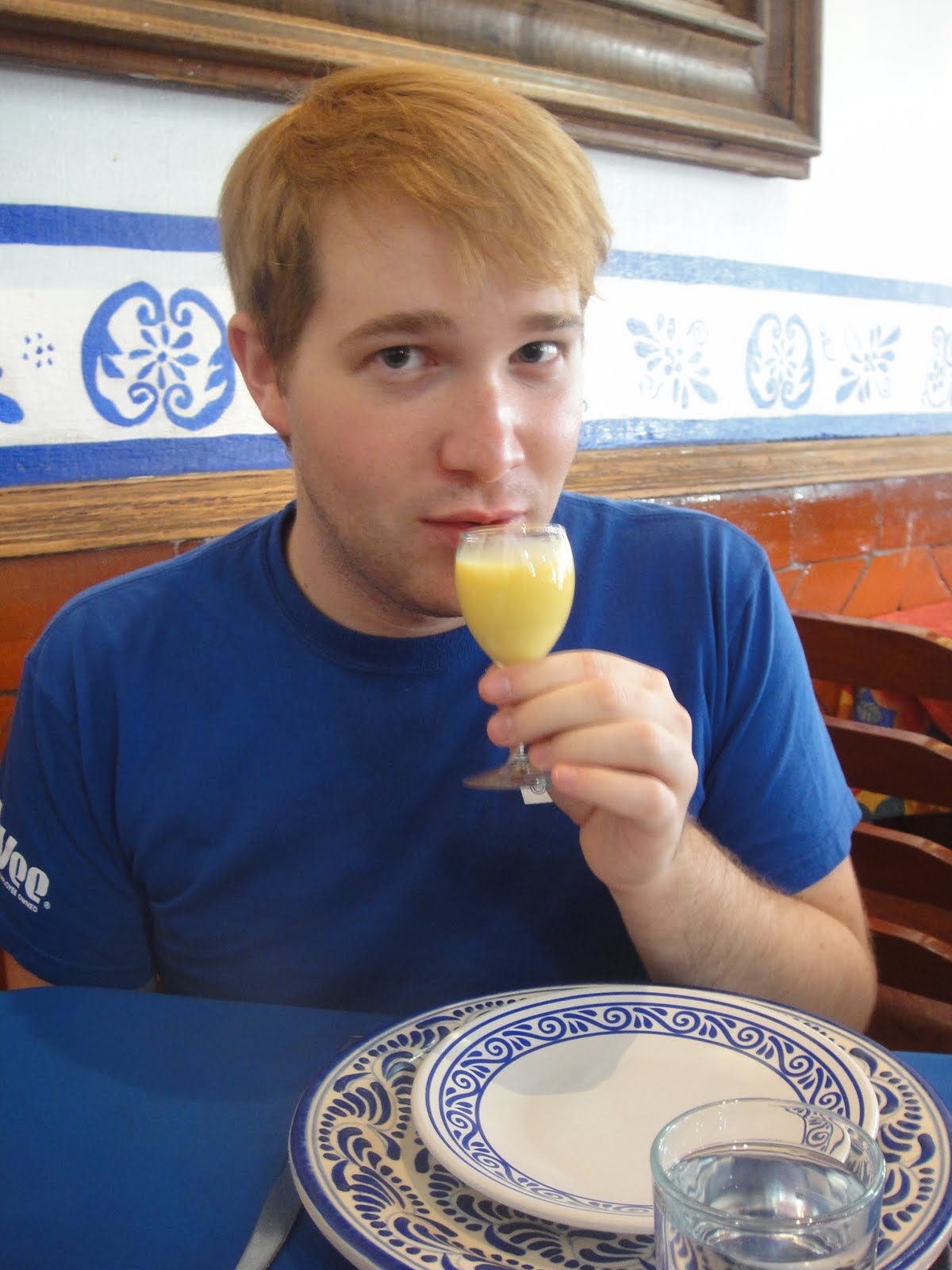
I also had Rompope, a thick egg drink laced with alcohol: egg nog. It was egg nog without the nutmeg. It is sipped as a cordial all year long.
I also ordered something that ended in "atole," which is usually a drink made with water and corn and then flavored with other ingredients. This one had squash blossom and chile. I was very interested to see and taste this atole, however it came in a soup bowl with half an ear of white corn. It was good, but not exactly the thurst quencher I thought it was.
After Jonathan and I both sat back and sighed at the same time, I knew our traditional Pueblan meal was over.
We walked a few blocks to candy street for dessert. Candy street, or 6 Oriente, it's city street name, is lined with candy shops. Signs for dulces tipicos redunantly hang over each shop. Some of them were started by nuns over a hundred years ago. Many of the candies were also created by the nuns in Puebla.
My Sweet Mexico has recipes for many, almost all of these confections. On the advice of Chef and author of the book, Fany Gerson, I stopped at a tiny bar I had walked by many times on my trips to the weekend markets: La Pasita. There, they serve a drink by the same name that is thier specialty. It is a raisin liquer served in a shot glass with a cube of salty cheese and a raisin on a tooth pick.
Today was as good an ending to my stay in Puebla as I could have wished for. I lunched on traditonal cusine and gorged myself on sugar candies until my teeth hurt.
Jonathan and I started out the day by having a huge lunch at la Fonda de Santa Clara, a very old, traditional Mexican restaurant that panders to tourists. It is not hoaky or cheesy, like most Mexican restaurants in the United States, it is simply all things traditionally Pueblan.
The menu contains everything necessary to taste while in Puebla, like a one stop "eat your way through Puebla" deal. There is also a list of seasonal specialties, this month's specialty is an Aztec dish of century worms (that's how it was translated into English) cooked in a chile sauce served with beans and guacamole. Jonathan said it was a delicacy so I was very excited to order it. Unfortunalty, they didn't have it. (How do you not have the monthly special?!?) So I settled for Puebla's most famous dish: Mole. Half way trough my plate, I swapped with Jonathan for his adobo pork and cuitlacoche.
| Mole: Chicken smothered in a complex sauce containing chocolate and nearly 100 other ingredients, sprinkled with sesame seeds and a side of rice. |
| It was difficult to see, but there was chicken under that sauce. |
| Adobo pork with Cuitlacoche and a side of guacamole. |
I also had Rompope, a thick egg drink laced with alcohol: egg nog. It was egg nog without the nutmeg. It is sipped as a cordial all year long.
After Jonathan and I both sat back and sighed at the same time, I knew our traditional Pueblan meal was over.
We walked a few blocks to candy street for dessert. Candy street, or 6 Oriente, it's city street name, is lined with candy shops. Signs for dulces tipicos redunantly hang over each shop. Some of them were started by nuns over a hundred years ago. Many of the candies were also created by the nuns in Puebla.
| Standing in the middle of Candy Street. |
| This woman was delivering marzipan roosters to one of the shops. Brightly colored marzipan animals are a common confection all over Mexico, but in Puebla, I only saw roosters. |
| Aside from the cartoonish aspects, they look like a group of real chickens looking every which way, don't they? |
| They were so adorable! I had to have one... or three... |
| Tortitas de Santa Clara: my favorite treat. |
| stacks of cookies and confections inside a shop |
| Sugar skulls! These are usually only seen around Day of the Dead in November, but I'm glad this shop sells them out of season. |
| These are little "cakes" of compressed, finely ground peanut. They look solid, but once you bite into them, they dissentigrate. Maybe that is part of the fun; they are really good though. |
| These are brightly colored wafer cookies. They also come shaped and decorated to look like all the popular cartoon characters. |
| First, you bite the cheese and drink the sweet liquer. |
Today was as good an ending to my stay in Puebla as I could have wished for. I lunched on traditonal cusine and gorged myself on sugar candies until my teeth hurt.
Thursday, May 5, 2011
Cinco de Mayo Explained, for Americans
This post is directed at my American readers:
Many Americans celebrate Cinco de Mayo, infact, it might be a fair statement that more Americans celebrate Cinco de Mayo than Mexicans. Do any of them know what they are celebrating? If you guessed Mexican indepenace, you're wrong. Don't feel bad, even many Mexicans don't know the origin of Cinco de Mayo and they certainly don't celebrate it. That is because it is a very regional holiday. The region: the city of Puebla, Puebla, Mexico.
So put down your Taco Bell and American "tacos" of ground beef flavored from a 50 cent packet from the grocery store, and pause your games of flip cup or beer pong with Corona to take time to read this post; so that you may actually toast the true heros of the day, before chugging another beer.
Remember for a second, the war of 1812: The United States was a young country, settled into its independance and busy becoming a great nation. The English, however, hadn't given up, they came back for more! We Yankees eventually kicked thier sorry red coats back to England, but not before they burned the White House and much of Washington D.C. to the ground.
Now, imagine that half way to Washington D.C., an out-numbered militia of poorly armed citizens defeated the "Red Coats" and effectively stopped the invasion of the young, independant country. Sounds great right? Well that is what happened on the 5th of May, 1862 just out side of Puebla, Mexico.
Mexico had already fought for independance from Spain and fought a civil war, leaving a fragile government, deeply indebted to France, Spain, and England. Napoleaon III, Emporor of France and grand son of Napoleon Bonapart decided to take action to secure France's interests. Apparently, the plan was to install a Frenchman as head of the Mexican government.
After landing in and conquering the port of Veracruz, the French started marching towards the capital, Mexico City. Between Veracruz and Mexico City, lies the city of Puebla. 4,500 poor civilians faced the 6,500 French troops and defeated them. Unfortuneatly, this did not end the invasion, but it weakened the French enough that the invasion eventually failed. The victory remains a cause for celebration in the city of Puebla, and unfortunaly, misunderstood by the rest of the world.
This morning I awoke very early to find a good spot on the parade route. I was ultimately rewarded for my loss of sleep. President Calderon, the president of Mexico was in attendace and I was blessed with a brief glimpse as he arrived in his motorcade of black SUVs. (unfortunaly, I don't have a picture) The parade opened with a large and impressive display of every branch of the Mexican military, which was greeted with shouts of praise and cheers of "Vive Mexico!"
After the military, the parade disentegrated into an extremely long chain of public school marching bands, only interupted by ramdon floats promoting Pueblan culture.
And finally, the parade finished with a lot men and women on horses.
Subscribe to:
Posts (Atom)