Friday, January 28, 2011

Does Mickey Work For The Chemical Companies?

I consider myself to be a very fair minded person; to be against something, you need to understand it. So if you will indulge me, I will try to explain an "evil" I stand against: synthetic chemical pesticides. I hated discussing this topic in the Food Ecology class I took my senior year at the Culinary Institute of America. I thought it was redundant and depressing. I prefer to focus on positive, ingenious problem solvers who are developing new techniques in agriculture to bring fresh, healthy food to the masses without the need for large monoculture farms supported with a myriad of chemicals that have adverse effects of humans, animals and the Earth.

This 1935 Disney cartoon reflects the mood of the time while being ahead its time: chemical poisons are the answer, however, there may be side effects.

OK, maybe I'm reading too much into this cartoon. It is not likely that Walt Disney or his animators were concerned about chemical use; DDT, the miracle pesticide, now banned, would not be discovered for three more years and the "golden age of pesticides" was not until the 40's and 50's. However, I find it to be prophetic and very poignant. Let me explain:

There has always been a serious battle between Man and pests. There is evidence that in ancient Mesopotamia, sulphur was dusted on crops to discourage pests. Over the centuries, farmers discovered other natural compounds like lead, mercury, and arsenic kept bugs at bay. In the 19th century, scientists began experimenting with synthetic compounds that did not break down quickly meaning that they did not need to be applied as often, were cheap, and did not appear to affect human health.

After the drought and depression of the early 1930's, I can see how DDT appeared to be a gift from God. Can you blame any poor Midwestern farmer for using it? On LivingHistoryFarm.org there is detailed history of farming in the Midwest during the "golden age of pesticides," including testimony by Diena Thieszen Schmidt about what battling the bugs was like without insecticides. "We did everything we could think of," she says. "We made noises at the end of the field. We smoked [set up smoke pots]. We tried everything to try to get rid of those army bugs."
To its credit, DDT effectively minimized malaria, typhus and countless insects and parasites against humans and crops. But at what costs?


In the 60's, the environmental movement began with the publishing of "Silent Spring" by Rachel Carson. She examined the widespread and unchecked use of pesticides. The title was meant to evoke a silent Spring season because all the birds had died. Later, it was proved that DDT effected not only insects, but some shellfish and many species of fish, as well as causing mostly birds of prey to lay eggs with very thin shells. The eggs would be too fragile to survive, thus the bird's populations dwindled. Not to mention the possible effects on humans: contaminated breast milk, cancer, male infertility, and diabetes.

How did Disney know? Not only does DDT effect more creatures than it was intended to, but now many  insects are immune to it. So it is not hard to understand why it was banned. The same is true about
modern pesticides, over use casues immunity and many unintended side effects. At least now, despite any flaws, pesticide use is monitored by the EPA.


Worst case scenario, in the future we could be facing the mutant insects that Hollywood has long foretold.
How would Walt Disney react today if he knew the true effects of using so many chemicals?

Would he have made a cartoon with an organic garden? Maybe. There are DDT supporters today who say the benefits outwiegh any controversial side effects. Keep in mind that organics prohibits the use of these synthetic chemicals, making crops vulnerable to anything. This reduces the yeild and means there would be less food available to feed an already hunger filled world. That is the major complaint against orgaincs, however it is not true. Have hope because there are natural deterants and techniques to protect crops. We are not lost without chemical poisons; don't rely on them.

Tuesday, January 25, 2011

I Have A Disease

Hi, my name is Jason and I'm an urban homesteader. OK, I'm not a homesteader but I'm addicted to the idea that I will be. I have been for a very long time; I used to think I just had a healthy fondness for gardening, but recently I have accepted that I have an addiction.

A homesteader from the beginning, here I am picking cherries in the backyard at 14 months old.

My gardening adventure at my first apartment in Orlando, FL. I should have seen the signs at the time. By the end of the summer, my little patio was full of pots of tomatoes, beans, mini pumpkins, sunflowers, basil, thyme, mints, rosemary, strawberries, and a pineapple. I always had some fresh vegetables for what little time I was actually home that summer. I was working 40-50 hour weeks at Primo By Melissa Kelly.
The seed catalogs know about me. They are my pushers, tempting me to embrace my desires and run away with my dreams. I have not ordered from one in more than five years, nor I remember ever signing up to receive one, yet in the last week I have received six, and a poultry catalog in the mail. I tried to resist, I tried to behave, but it was impossible. I went on a gardening binge, spending hours flipping through their tempting pages. Many hours of sleep were lost thinking about uprooting a yard I do not have to cultivate the garden of my dreams.
It is a dangerous addiction. I spend all my time researching ways to raise small livestock like rabbits, chicken, quail, pigeons, fish, etc. in the backyard. I once blurted out at a gathering of friends that "people underestimate me, but I spent all weekend researching peacock genetics!" I don't really want to raise peacocks in my backyard, they are lovely creatures except for their screech like crow. Besides, have you ever heard of someone with a peacock in the backyard? (Actually, I have! My two great Aunts, who live in a tiny Alpine village have a pet peacock named Hansi, but that story is for another post.)

Now, I am coming down off my seed catalog high and the cold slap of reality is setting in: I can't homestead now because I don't even have a yard. I travel too much, there are still too many things I would like to do before I have commitments like a house and an urban farm. The pressures of living with people who don't understand my disease force me to conform. I take my dose of "medicine" (bland, insipid GMO produce from Chile) which sedates me into living a "normal" life, eating "normal" food, that some scientist modified genetically to make it grow "normally." Then it was boxed and shipped hundreds of miles to my "normal" grocery store, where my mother bought it to cook a "normal" dinner. The masses eat this "medicine" everyday and they like it. They buy it on sale and say it tastes wonderful. If someone doesn't like that flavor of "medicine," they can buy 1000's of processed combinations of rearranged corn. (I guarantee every boxed item and meat product you buy has some form of corn in it)Is there a cure for someone like me? Someone obsessed with a need to eat at least something that they grew and harvested, is there any help for those of us that cannot tolerate "normal medicine?"

There are those who also suffer with my affliction and they embrace it. They are my heroes. Rachel, of Rachel's Tiny Farm, is probably my favorite homesteader. I am constantly amazed by the things she accomplishes in her Arizona backyard. This is not even her full time job, she just wants to provide fresh, healthy food for her family. Barbra Kingsolver wrote a wonderful book, "Animal, Vegetable, Miracle" with her family about their story of moving to Tennessee to eat locally and farm their own food. If you want to see a full scale working urban farm operation, the Dervaes family created it. Their whole life style is about growing organic food in their yard and it is their only source of income. If you think you might be infected like me, their Path to Freedom website will inspire you!

Slowly, awareness and thus, acceptance for my disease is spreading. If you think you might be catching the germs, I urge you to embrace them! Then infect everyone you know, especially your family. Do the bare minimum and plant heirloom tomatoes and a few vegetables your family will enjoy over the summer. If you enjoy that, plant a fall garden. There are many vegetables you can grow right up to first snow and store some for the winter. If you don't have a green thumb, visit your local farmer's market. It is 2011, every city in the country has one! Buy your produce there and support those who have a severe case of the disease; they grow so much food, they have to sell the excess. If you do nothing else, please, challenge yourself not buy "medicine."

Monday, January 24, 2011

I Heart Baozi: Chinese Steamed Buns

The last and final food in my special food series is Chinese Dumplings. Last April I was blessed with the opportunity to travel to China with the lovely and very talented Chef Shirley Cheng. Chef Cheng is an instructor at the Culinary Institute of America and every few months she arranges for a hand full students to take a three week culinary tour of China. I was lucky to be on the first school sponsored trip, travelling with Chef Cheng herself. We spent the first half of our trip in Chef's home town of Chengdu. Next, we flew to Xi'an (a sister city of Kansas City) and finished our trip in Beijing. There were dumplings to be had everywhere, but the best were in Xi'an. It is famous for its dumplings and dumpling banquets. Large halls fill with people everyday to be served large steamer baskets of dumplings. The dumplings come in every shape and flavor, actually the two are correlated. The dumpling is shaped to look like the filling.
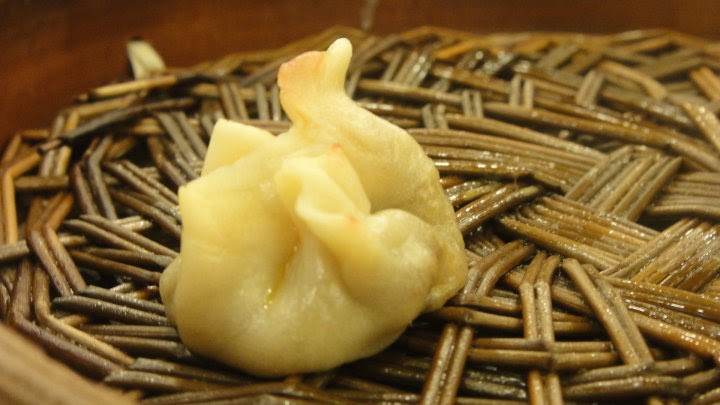
This is the last, lonely chicken dumpling from our dumpling banquet in Xi'an.
Every morning we had great big Baozi(bao- tze), steamed dumplings, for breakfast. In Chengdu, we spent a day at the Sichuan Culinary Institute where a master chef, and former student of Chef Cheng demonstrated several Chinese dishes including Boazi.


The master Chef shows us the steam bun dough.
First, portion the dough and flatten it with your palm.
Chef Cheng demonstrates how to fill and form the dumplings.
First, spoon the filling onto the flattened round of dough.

Push the filling down with your thumb and draw the edges of the dough up.
Keeping your thumb in the center, pinch the edge of the dough together.

Keep pinching the edge of the dough all the way around until you have closed dough around the filling.
Chef Cheng's perfect dumpling in the steamer.
 Mine looked just like that so it would be redundant to post a picture of it... haha!
For the graduation open house I made some pork and cabbage Dim Sum dumplings with a ginger soy dipping sauce.

Sunday, January 23, 2011

The Elusive Tortitas de Santa Clara

Tortitas de Santa Clara have proven to be quite elusive. Fortunatly I was able to make some and feature them here as the next food in my meanigful food series.

These cookies are a specialty of the city of Puebla, where Jonathan is currently going to culinary school. Puebla is known for many things: the battle of Puebla (the reason for Cinco de Mayo), mole, and many many confections. Being a pastry chef, the confections interest me most. There is a whole street lined with confection shops. Most of them were started over a century ago by nuns.

Last September, fellow pastry chef and CIA alumna Fany Gerson published a great book called "My Sweet Mexico." It is filled with some of my favorite confections from Puebla and all of the recipes are simple to understand even for non pastry chefs. The book is also filled with beautiful pictures of Mexico, its culture and its food.

I have two small critiques of the book: it lacks recipes for horchata, a rice milk beverage and tortitas de Santa Clara, though it does refer to them and show tempting pictures. In Ms. Gerson's defence, in my own experience, people who make great horchata are very secretive about their recipe and the few recipes that I have seen seem to have all different methods. As for the tortitas de Santa Clara, that must be a very closely guarded Puebla secret that even she couldn't find because when I Google searched for a recipe, I only found one archaic recipe that was not easy to follow.

Whatever the reason for the secretiveness, these hard to find cookies are cemented as my favorite treat from Puebla.

Saturday, January 22, 2011

Hunger and Taquitos

I have spent more time in Mexico than any other foreign country so it is only fair that it gets two items. A sweet and a savory.
This is the savory food: taquitos durados. Last summer I spent about two and a half months with my boy friend Jonathan. I had plenty of money saved for the trip, however, just about every bill I could have, came due the week before I left. Doing the responsible thing and paying them all in full left me about $300. So I had a little over $100 to spend each month. That should be plenty right? It's Mexico! That was everyone's reaction... however, even in Mexico $100 a month doesn't quite cut it. I was living rent free thanks to the generosity of Jonathan's family, but I contributed to food money and paid my own way for everything else. It was extremely frustrating to go into the grocery store and every other item was too expensive for my budget. Here in the states, Bell peppers adorn Mexican food like confetti. I wanted to buy a green one, normally about a dollar at home, it was about three dollars in Mexico! I was astounded! Due to our budget and Jonathan's and my laziness to go grocery shopping there were times I was hungry. I was never starving, don't get me wrong, there were plenty of times that I ate very well. However, there were also times that I was hungry for more.
One night, I needed something to put in my stomach and I sliced about half a head of ice berg lettuce, a slice of onion, and a slice of tomato and put salad dressing on it. Jonathan walked in a commented that I was eating half the head of lettuce. Hunger grumpiness had set in at that point and I snapped back that lettuce was just water, had no nutritional value and was very cheap, so shut up and let me eat!
There were times that I was amazed at how full I was after eating so little. Like eating tacos durados for instance. Jonathan would boil one chicken breast and then shred it. the chicken would be distributed between a pack of corn tortillas, rolled up and fried. Then each of us would get a bowl of the chicken broth(boiled chicken water), three or four taquitos, lettuce, tomato, crema, and salsa and I would be full! Amazing.
I ate many things that were delicious that trip, but this dish sticks out in my mind most.

Friday, January 21, 2011

Brioche: My Obsession

Brioche. I get a food boner just thinking the word. I'm slightly obsessed with it. When food blogger Tony Tahhan came to visit the CIA we had a great conversation about blogging, bread and especially brioche. He wrote a whole blog post about our conversation.
I love brioche because it is a wonderful wonderful half bread, half butter pastry.  It is so classic, yet so versatile. It can be full fat, half fat, whole wheat, sweet or savory; either way it makes great hamburger buns, french toast, waffles, donuts, pastries and if you feel particularly naughty you can laminate it!(the process of folding butter in between layers of dough)
During my time in back of house Apple Pie Bakery Cafe (APBC), the student run cafe at the Culinary Institute of America, I worked the brioche station. Every morning I was responsible for making a slew of pastries made out of brioche. During my class evaluation with the chef of the cafe, Francisco Migoya, he made a comment to me that brioche is so versatile that you could have an entire bakery of brioche products. I don't know if he saw that light bulb switch on over my head but he planted a seed that day. I had long been an ardent rejecter of any notion that I would one day own my own place. "too much work" I always replied, but secretly, I day-dream about a successful bakery cafe that only sells brioche products. Of course it would have to be somewhere where the customers do not care about butter consumption... maybe if Paula Dean sponsored it...
There are any number of ways that I could make a brioche item for my graduation open house. Since I'm having a hard time picking one, I'll make three. The first is my take on one of the pastries I made at APBC: a brioche fruit tart. The second is a miniature version of the national bread of Belgium: Craquelin. The third is another classic Belgian preparation: a waffle.

Brioche can be difficult to make at home, you need a strong, powerful mixer. My professional series Kitchen Aid is a very strong mixer, however, every time I make brioche I put it within seconds of overheating and breaking. To give my mixer a break, I usually start the dough in the mixer until it comes together. Then I remove the dough and hand knead the dough to full gluten development.
This can take quite a few minutes and gives my arm muscles an intense work out!
After the dough has reached intense gluten development, I return it to the mixer and start adding butter, small pliable pieces at a time until it is all incorporated.
This is called the window. It shows gluten development. If the dough pulls apart when stretched, the gluten development is light. If you can pull the dough very thinly and see light through the other side without tearing holes in the dough, it has reached full gluten development.
These are the baked Craquelin: brioche wrapped around sugar cubes.
 waffled brioche dipped in fondant
citrus vanilla custard brioche tarts with orange marmelade

Thursday, January 20, 2011

Chocolate Maker's Mark Bottles

The next item on my meaningful food series is another chocolate. This combines a favorite technique I learned in chocolate class and my alcoholic drink of choice: Maker's Mark Bourbon.
One Thanksgiving a few years past, my best friend, Christian and I decided to drive to her house outside of Louisville because it was about six hours closer to our New York campus than Kansas City. We had a blast on our weekend 14 hour road trip each way. When we arrived, Christian really wanted to drink our way through the Kentucky Bourbon Trial and who was I to say no?! We started at Maker's Mark distillery, which really is a shame. My advice to anyone who is interested in doing the bourbon trial, save Maker's Mark for last because it truly is the best and will put all the others to shame! All of the other distilleries have some kind of self guided gift shop/ hallway that explains the bourbon making process. At maker's Mark, you drive out to the middle of who knows where and pull in a long winding drive. The distillery is dwarfed by all the others, the buildings are black and every window is adorned by bright red shutters with the shape of a bottle cut out. There is an old wooden covered bridge and being that it was the holidays everything was adorned by a bright red bow. If my description sounds so sweet and adorable it is giving you cavities, then stop reading because it only gets more charming.


These are the open mash tanks. The whole room smelled very very yeasty. Yum.
We were heartily greeted by every person we passed on our way inside the visitor center. We were given a tour by a descendant of the founder and she knew the name of every employee we passed. That might be more impressive if there were more than about 50 employees total. We saw every step in the process and were even allowed to taste the sour mash if we desired.
At the end of the tour, we entered a large gift shop where you can buy anything dipped in red wax. If somehow they forgot to dip something, you can dip it at the bottle dipping station in the gift shop. Of course I HAD to dip my own commemorative bottle.
The chocolates I am making for the graduation open house where I am featuring these special foods are mini chocolate Maker's Mark Bourbon Bottles. It is a very difficult technique that I did in school and have tried three times at home and have never been successful. I am determinded to make these work!

The first step is to mold a tiny bourbon bottle out of polymer clay and fill up a shallow sided cookie sheet with regular corn starch. Bake the corn starch and the clay bottle in a low oven. The bottle should take about 10-15 minutes and the corn starch should be baked for several hours and even over night. This dries out the corn starch, it is a very important step! If the cornstarch is not dried out, it will just obsorb the liquor syrup and you will just have a big mess. Tip: make sure you have more than enough dried corn starch to fill the baking pan AND plenty to dust over the top later. I once made the mistake of not drying enough and dusted fresh corn starch over the top and it just obsorbed into the syrup.

The second step, once the corn starch is dry, is to level it and press the clay bottle into the starch. This is a tidious and frustrating step. Every ridge, tiny ball of starch and imperfection will be evident in the finished sugar mold and could show in the finished chocolate. Tip: make plenty of molds because you will inevitably break several along the way.


The third step is to cook your sugar syrup and add the liquor. This step is much easier when you have the proper equipment: a fondant gun. Unfortunatly I don't have the funds for a proper fondant gun or any other suitable substitute. So I ghetto rig an aluiminum foil cone and wrap it in tea towels or anything else I can put between my fingers and 200 degree sugar. However I still use my bare finger and thumb to pinch the tip as I move from mold to mold. My fingers are burnt by the time I finish, but the end result is worth the sacrifice.

The fourth step is to dust the extra dried corn starch over these molds. Make sure they are well covered. The starch draws moisture away from the syrup and causes the sugar to crystalize and form a shell all the way around.

The fifth step is the most fun and also the most infuriating becasue this is when the most bottles break. After the bottles have been crystalizing in the starch for a day or two depending on the size of your bottles, very carefully escavate the bottles out of the starch. Using a clean pastry brush, gently brush away as much excess starch as you can. Tip: if the bottles break, over the starch, just cover the syrup with starch and allow it to recrystalize. It makes the cleaning process much easier.
The sixth step is to dip however many surviving bottles you have in well tempered chocolate. If you have bottles that have a tiny hole that slowly seeps syrup, you can still dip it. However, if the syrup is rapidly leaking out, just cut your loss and pop it into your mouth. Decorate the bottles to mimic the bottle of which ever liquor you use; I colored white chocolate bright red to drip over the top of the bottles.


These chocolates can be infuriating to make, but they are fun and always impress! Don't worry about getting drunk, you will get sick from the sugar long before you feel the effects of alcohol.
Inside the bottle: you can see the crystalized sugar and the liquor syrup pouring out.